
Matariki Degustation Dinner Showcases Ākonga Innovation and Cultural Connection
Thursday, 02 Jul 2026
As the Matariki stars rise in the midwinter sky, Aotearoa enters a time of reflection, connection and renewal. Known as the Māori New Year, Matariki signals a moment to remember those who have passed, celebrate the present with whānau, and look ahead with intention to the year to come.
At the Toi Ohomai Institute of Technology Mokoia Campus, those principles were brought to life through food, storytelling and hands-on learning for ākonga.
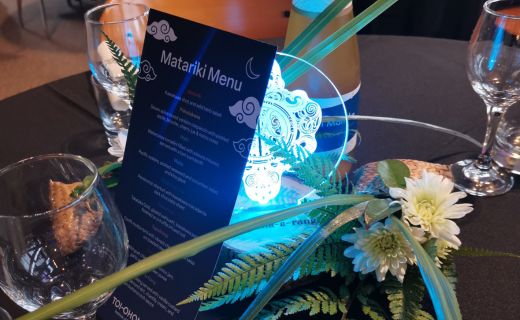
The Kaiwhata Restaurant was transformed for a special nine-course Matariki degustation dinner, where each dish represented one of the nine stars in the Matariki cluster. The result was an immersive dining experience that blended cultural meaning with culinary innovation, while placing ākonga learning firmly at its heart.
Senior Academic Staff Member Craig Searle said the concept challenged students to think creatively while staying grounded in tradition.
“The Matariki theme is inspired from the Māori New Year and the celebration of Matariki. Each course is based around the nine stars, so we try and match a food style to the star,” Craig said.
That connection to kaupapa Māori extended far beyond the plate. Ākonga took an active role in shaping the atmosphere and narrative of the evening, weaving tikanga, storytelling and visual design into the experience.
“You cannot get any more cultural than our ākonga doing the karakia in a very confident manner in front of our kaumātua,” Craig said.
“We also had students putting PowerPoint presentations together about the stars and what they represented, which were projected throughout the night.”
The event was designed as a fully immersive, real-world learning experience. Level 3 Food and Beverage students were responsible for front-of-house service, gaining practical skills in hospitality, while Level 4 culinary ākonga led menu design, development and execution alongside their tutors.
“Jonathan Chemis and his Level 4 culinary ākonga pretty much did the bulk of the menu design and testing,” Craig said.
“Our Level 3 students were hands-on with service. They polished glasses, set tables, and gained an understanding that those finer details make a difference.”
Tik Wan Tan and his level 4 bakery ākonga also got involved and created desserts for the menu.
Seasonality and locality were central to the menu, which showcased indigenous ingredients and celebrated the region, which is a reflection of Matariki’s focus on gathering and sharing food.
“All produce had to be seasonal and very much focused on indigenous ingredients. We even had hand-dug truffles from our next-door neighbour, you can’t get more local and fresher than that,” Craig said.
Guests embraced the experience, with standout feedback for dishes such as the seven-spice cured venison carpaccio and wild goat chipolata, although Craig said the overall standard made it difficult to single out favourites.
Delivering a nine-course degustation for more than 40 guests required precision, collaboration and adaptability, key skills for students preparing to enter the industry.
“Having the resources to deliver nine courses takes a lot of thought,” he said.
“Planning and communication were essential, and designing a menu around the stars required some real lateral thinking.”
For many ākonga, the evening provided them with a confidence boost.
“We had some very shy, quiet ākonga volunteering to help with service, and that really helps them grow,” Craig said. “This is real-world, hands-on learning. They’re not doing a theoretical assessment, they’re living it.”
A highlight for students was the recognition they received from Toi Ohomai CEO Pim Borren, who visited the kitchen to personally acknowledge their efforts.
“It was huge for the students, they were all blown away by that recognition,” Craig said.
Underpinning the success of the event were the Toi Ohomai values of manaakitanga, whanaungatanga, kotahitanga and toitūtanga, principles reflected not only in the service and food, but in the way students supported one another to achieve a shared goal.
Looking back, Craig said the most rewarding outcome was seeing ākonga step into their potential.
“We’re most proud of the growth of our ākonga. Seeing them take the knowledge and put it into practice,” he said. “The feedback they received will give them the confidence that they can succeed.”