
New Tukutuku Brings the Story of Tāne to Life at Toi Ohomai
Friday, 12 Jun 2026
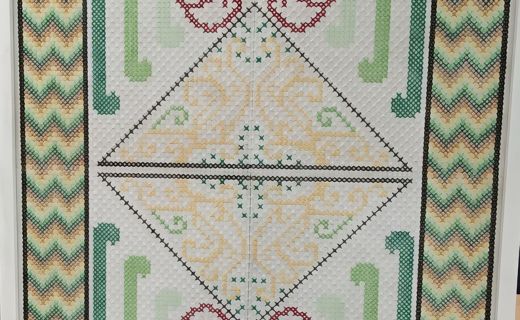
A striking new tukutuku panel, Te Ngahere o Tāne, is now on display in the Upper Ātea, offering kaimahi and ākonga a visual connection to te ao Māori and the story of creation.
Created by Toi Ohomai Māori Success Partner Marcus Brons, the work is one of three tukutuku panels he has developed, each exploring a different part of the natural world and its place in Māori pūrākau: Te Whenua (the land), Ngā Pūrakau o te Moana (stories of the ocean), and now Te Ngahere o Tāne (the forests).
Marcus describes this latest piece as the culmination of that journey.
“It speaks to the creation story in te ao Māori,” he says. “Tāne was instrumental in separating his parents, Ranginui and Papatūānuku, which allowed light and life to flourish. He also created the first human, Hineahuone, the beginning of all human existence. Because of that, I left this story for last.”
At the heart of Te Ngahere o Tāne is the moment of separation, when Tāne pushed apart Ranginui (Sky Father) and Papatūānuku (Earth Mother), allowing light to enter the world and making life possible.
“That separation is what allowed the forests and all living things to exist,” Marcus says.
“Tāne became the progenitor of all tangata whenua.”
The tukutuku is rich in symbolism. On either side of the panel, colourful columns represent Ranginui using the niho taniwha (shark’s tooth) pattern, a design associated with strength and leadership. The colours themselves reflect the light that entered the world following the separation.
At the centre sits Papatūānuku, depicted through a diamond form surrounded by patterns representing the forest, trees, undergrowth and life in all its forms. Within this shape are smaller elements symbolising mauri, the life force from which all living things originate.
Balance, or utu, is another key theme. The symmetry of the design reflects the equilibrium that exists in te ao Māori between opposing forces, Te Ao Mārama (the physical world) and Te Pō (the spiritual world), as well as concepts like night and day, and good and evil.
While grounded in mātauranga Māori, Marcus is careful to acknowledge the distinction between traditional and contemporary toi.
“These art forms are taonga that belong to Māori,” he says. “Contemporary artists can incorporate these patterns, provided they are interpreted correctly and their mana is respected.”
This respect underpins every aspect of the work, from design through to execution.
Creating the tukutuku was both technically complex and deeply collaborative. Marcus began by designing the pattern digitally using Excel to map out a symmetrical grid of about 10,000 holes per panel.
The panels themselves were laser-cut by Creative Industries technician Karolina Bemova, while Carpentry technician Dirk De Vries built the wooden frame to support them.
From there, Marcus hand-wove each panel using coloured acrylic yarn and traditional stitching techniques, a process that took about 40 hours per panel. Once complete, the panels were assembled and stitched together, bringing the total time investment to around 200 hours.
“Design is the most time-consuming part,” Marcus says. “Each colour and pattern has meaning, and you have to ensure they’re used appropriately to enhance the mana of the story.”
Initially, he considered a more literal design featuring forest imagery and figures of Tāne, but ultimately chose a more symbolic approach.
“Tukutuku is very mathematical, so symbolism works better. I was also guided by karakia throughout, it’s a deeply spiritual undertaking. Every decision affects the wairua of the work.”
For Marcus, the tukutuku panels are more than artworks they are personal expressions of connection to the world.
“Each piece has its own mana to me. They speak to me when I see them,” he says. “Together they reflect the beauty of Te Ao Mārama, the land, the seas and the forests, and they help me see the world in a more spiritual way. They calm my spirit.”
Te Ngahere o Tāne is currently located in the Upper Ātea library, near Student Services, where staff and students can view the piece up close. An information booklet is available alongside the artwork to help viewers explore its meaning and symbolism.
Marcus hopes the tukutuku will invite people to pause and reflect.
“It’s about seeing the world around us differently, understanding the stories behind it, and the balance that exists within it.”